
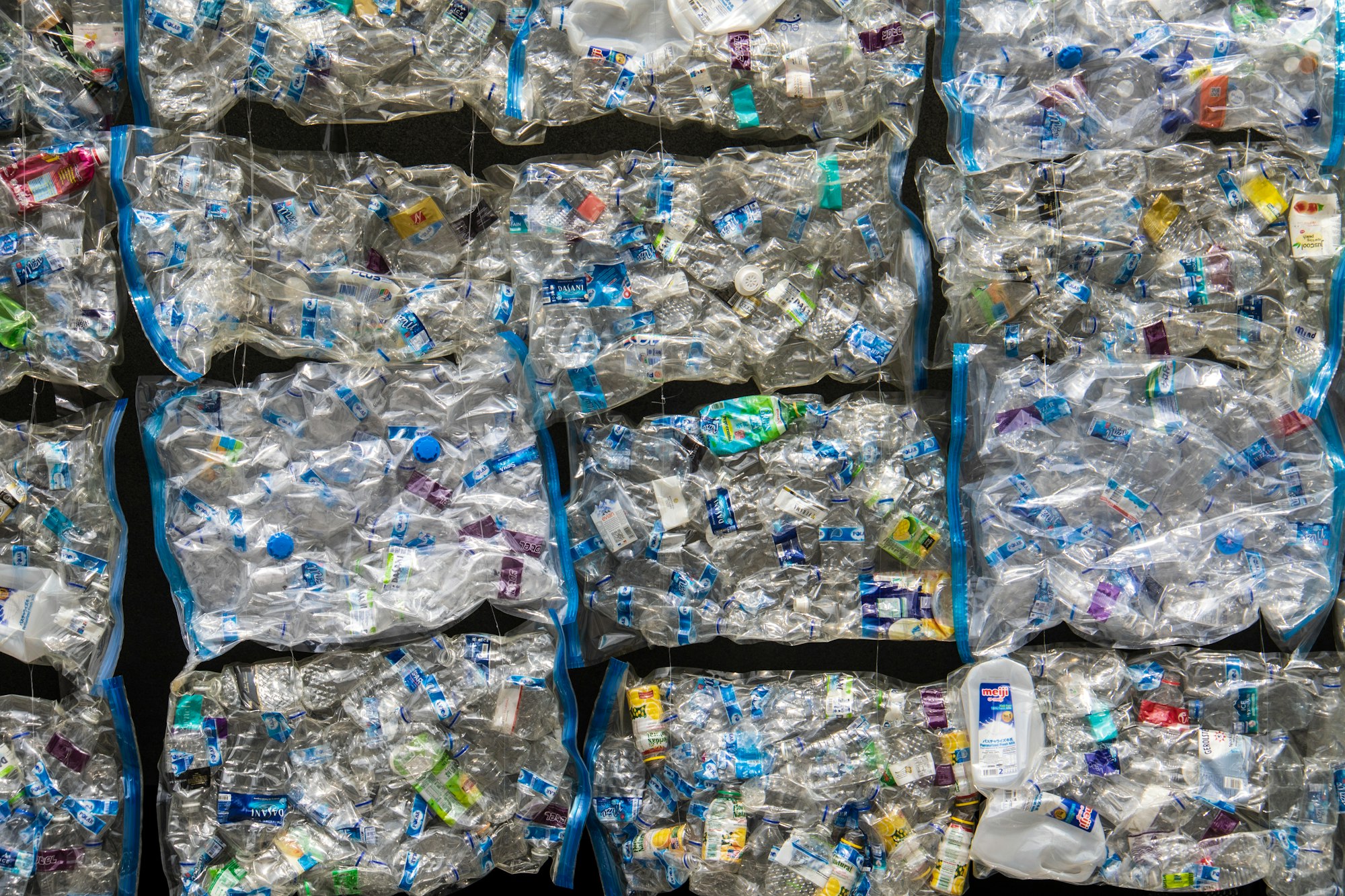
Every rPET pellet starts as a used bottle. Between the two lies a sequence of sorting, cleaning and processing steps, and each one removes something that does not belong in the final material. Here is how the process works, stage by stage.
1. Bales
Post-consumer PET arrives compressed into bales. The bales are broken open so the bottles can be fed into the line loose.
2. Bottle sorting
Sorting removes everything that is not clear PET:
- Metal separators and eddy current systems take out metals.
- De-labelling and ballistic separators strip labels and separate flat items from bottles.
- Near-infrared (NIR) sorters identify the polymer of each item and reject anything that is not PET.
- Colour sorting separates clear bottles from coloured ones.
- A final manual check catches what the machines miss.
3. Grinding and washing
The sorted bottles are ground into flakes in a wet grinding process, then washed in hot and cold stages to remove glue, label residue and dirt.
4. Flake sorting
A second round of NIR, polymer and colour sorting works on the flakes themselves, removing any remaining non-PET material and off-colour pieces.
5. Extrusion
The clean flakes are melted and extruded. A vacuum system degasses the melt, drawing out moisture and volatile substances.
6. Improving quality
The pellets are crystallised and then go through solid-state polycondensation (SSP), which raises their intrinsic viscosity to the level needed for bottles and removes odours.
7. Quality control
Testing runs from start to finish, so that viscosity, colour and acetaldehyde stay consistent from one batch to the next.
8. Resin
The result is high-quality post-consumer recycled (PCR) PET resin, including food-grade PCR PET, ready to be made into new bottles, preforms, sheet and other packaging.
Taken together, the stages narrow the material down until only clean PET remains. That is what allows a bottle collected after use to come back as packaging of the same quality.